
In one of the 16 true stories collected for Late to the Party: Extraordinary Stories of Hope After Late-Identified Hearing Loss by Valerie James Abbott, Beth and Josh’s firstborn Alexis failed the automated auditory brainstem response (AABR) a few times before she was discharged from the hospital.
By the time Alexis was three months old, Beth and Josh had participated in more than 20 different hearing health discussions with professionals who claimed they could assess her hearing. At the conclusion of each appointment, “none actually completed a hearing screen or diagnostic evaluation with a solid confirmation of no hearing loss. There were always excuses followed by: ‘I think she’s fine, but let’s reschedule and try again in a few weeks if you want to.’”
Alexis was finally diagnosed with moderate to severe sensorineural hearing loss at age 4. This late identification presents a whole new slew of challenges compared to families whose children are diagnosed at birth and immediately connected to resources, technology, and support.
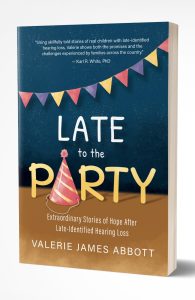 Sadly, Alexis’ story is not unique. Many stories share commonalities, such as inept and dismissive medical professionals and rural disparities. Abbott’s writing is engaging and draws the reader in. The acronyms and abbreviations used throughout are listed at the beginning, which makes more sense than the usual placement at the end. Each chapter begins with a relevant quote, like one from Milan Kundera: “We pass through the present with our eyes blindfolded. We are permitted merely to sense and guess at what we are actually experiencing. Only later, when the cloth is untied, can we glance at the past and find out what we have experienced and what meaning it has.”
This rich collection of stories covers a range of experiences, touching upon unilateral hearing loss, CMV, premature birth, and lifesaving treatments that have an increased risk of hearing loss. While these stories can be heartbreaking and infuriating, there is also hope. Despite the slow starts, these children are thriving with the resources they need.
The book ends with a call to action. Years after Abbott’s daughter was late-identified, the gaps, shortages, and AAP recommendations have remained unchanged. Here’s hoping this book will make a difference.
If you want to learn more about the author’s journey and how you can advocate more effectively as a parent, Abbot will be speaking in an upcoming AG Bell Parent Chat. Register today to learn more about navigating late-identified hearing loss.
You can read more about the process of writing this book and its author here.
Historias de resiliencia tras un diagnóstico tardío
Uno de los 16 relatos reales recopilados para el libro Late to the Party: Extraordinary Stories of Hope After Late-Identified Hearing Loss (Llegar tarde a la fiesta: historias extraordinarias de esperanza tras una pérdida auditiva identificada tardíamente) de Valerie James Abbott trata de Alexis, la primogénita de Beth y Josh, que no superó la prueba de potenciales evocados auditivos del tronco cerebral automatizados (PEATCA) en varias ocasiones antes de que le dieran el alta hospitalaria.
Cuando Alexis tenía tres meses, Beth y Josh ya habían acudido a la consulta de más veinte profesionales de salud auditiva que aseguraban poder evaluar su audición. Al final de la consulta, «ninguno de ellos llegó a realizar una prueba auditiva ni una evaluación diagnóstica que confirmara de forma fehaciente la ausencia de pérdida auditiva de la niña. Siempre había excusas: “Creo que está bien, pero concertemos otra cita y probemos de nuevo dentro de unas semanas, si lo desean”».
A Alexis finalmente se le diagnosticó una pérdida auditiva neurosensorial de moderada a grave a los 4 años. Este diagnóstico tardío plantea toda una serie de retos nuevos en comparación con las familias cuyos hijos son diagnosticados al nacer y tienen acceso inmediato a recursos, tecnología y apoyo.
Por desgracia, la historia de Alexis no es única. Y muchas de estas historias comparten puntos en común, como profesionales médicos incompetentes y poco empáticos, además de las desigualdades en las zonas rurales. La prosa de Abbott es cautivadora y atrapa al lector. Las siglas y abreviaturas utilizadas a lo largo del libro se enumeran al principio, lo cual tiene más sentido que la ubicación habitual al final de un libro. Cada capítulo comienza con una cita relevante, como esta de Milan Kundera: «Atravesamos el presente con los ojos vendados. Solo se nos permite intuir y adivinar lo que realmente estamos viviendo. Solo más tarde, cuando se retira la venda, podemos echar un vistazo al pasado y descubrir lo que hemos vivido y qué significado tiene».
Esta excelente recopilación de relatos abarca una amplia gama de experiencias, que abordan la pérdida auditiva unilateral, el CMV, el parto prematuro y los tratamientos que salvan vidas pero que conllevan un mayor riesgo de pérdida auditiva. Aunque estos relatos pueden resultar desgarradores e indignantes, también hay esperanza. A pesar de los comienzos difíciles, estos niños prosperan en la vida gracias al acceso a los recursos que necesitan.
El libro termina con un llamamiento a la acción. Años después de que a la hija de Abbott se le diagnosticara tarde la pérdida auditiva, las carencias, las deficiencias y las recomendaciones de la AAP siguen sin cambiar. Esperemos que este libro marque la diferencia.
Si desea saber más sobre la experiencia de la autora y cómo puede defender los intereses de su hijo(a) de forma más eficaz como madre o padre, Abbott intervendrá en una próxima charla para progenitores de AG Bell. Inscríbase hoy mismo para obtener más información sobre cómo afrontar un diagnóstico tardío de pérdida auditiva.
Puede leer más sobre el proceso de escritura de este libro y su autora aquí.
