
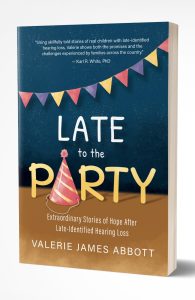
Valerie James Abbott’s second book, Late to the Party: Extraordinary Stories of Hope After Late-Identified Hearing Loss, published on May 5, is a one-of-a-kind collection of true stories that illustrate what happens when hearing loss is identified later, outside of newborn hearing screening. And for Abbott, the topic is personal.
Motivation
As the parent of a late-identified child, Abbott’s experience was noticeably different from families of children who were identified through the newborn hearing screening process. Those families knew from the start their child had a hearing loss and were connected to the right tools early on, whereas families like Abbott’s had to figure it all out later. As a result of late-identification, Abbott’s daughter Bridget (Bridie) was developmentally delayed.
“We were carrying guilt and panic and worry that just seemed different,” Abbott recalls. “I felt very much like my child and our family were the odd [ones] out. We didn’t learn until many years later, after meeting many other families of children with hearing loss, that we were actually in good company. There are just as many children who are late-identified as there are children with congenital hearing loss, and some data implies there is far more.”
When Abbott listened to story after story of the significant social-emotional, developmental, and academic impacts late identification has on children, and the strain of parents’ experiences, she started to wonder why hearing health monitoring between birth and school age continues to be a bottom priority in the United States. It occurred to her that perhaps it is because the “truth about late-identification” hasn’t made headlines. As a parent advocate for early childhood hearing loss, she realized she could change this.
 Starting the Book Project
The spark was lit in 2024 after the International Journal of Audiology published the article, “A systemic review of the prevalence of late identified hearing loss in childhood.” Dr. Karen Muñoz at the National Center for Hearing Assessment and Management (NCHAM) and several other leading researchers invited Abbott into conversations back in 2023 that led to the extensive literature review for the article. While there were several key takeaways from the article, Abbott wanted them to reach a bigger audience.
Abbott met with Kim Eley at KWE Publishing, LLC, in the fall of 2024 to pitch her book idea, featuring a dozen or so true stories of late-identified children. They mapped out a timeline and officially announced the project in March 2025 at the national Early Hearing Detection & Intervention (EHDI) Conference, where Abbott began recruiting story submissions. Word of mouth spread quickly, and within two months, Abbott had 19 families who wanted to participate. She narrowed it down to 16 and interviewed them on Zoom in the summer of 2025.
Ironically, after paring down the submissions to 16 families, Abbott truly thought the number would eventually naturally scale back to 12. This never happened, as all of the 16 stories were compelling, and none of the families dropped out.
“They all recognized the value of their story in improving outcomes of children with late-identified hearing loss,” Abbott says. “So, the book is bigger than I expected it would be, but honestly, it is also better than I expected as a result of the collection. Each of them makes the whole.”
A Family Endeavor
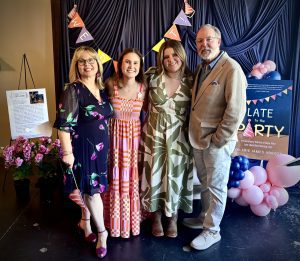 Abbott’s daughters, Bridie, now 20, and Mary Clare, 23, were able to join her for several of the interviews. As she thought about the interviews after, wrote the chapters, and handed them over for feedback, Bridie and Mary Clare recalled many of the details and personalities and had “wonderful feedback.” Just like her first award-winning book Padapillo–—based on the true story of how the family discovered and came to terms with Bridie’s hearing loss–—this book really was a family project.
“My name might be listed as the author, but my husband Chris and my daughters were my first line editors for every chapter,” Abbott says.
The Stories
Not all the individuals in the book were late-identified, though all the main characters are children. Some parents of the children with early childhood hearing loss were also late-identified, which brings a unique perspective to their stories. Abbott says this was incredible to explore, as these parents were not only unpacking some of the emotional memories of discovering that their child had hearing loss, but also sharing the intimate details of how they themselves came to terms with or struggled with their own hearing loss.
“I’m getting emotional myself just recalling those interviews and how open those family members were when they spoke to me,” Abbott says. “Their courage was something to witness.”
Reaching the Right Audience
Abbott had two target audiences in mind when she was writing her book. Naturally, the main audience is families of children who are late-identified. Abbott has found that while this demographic shares some challenges as families identified through newborn hearing screening, their experiences are different. How they face the diagnosis and make decisions is also sometimes different.
The second target audience comprises audiologists and speech-language pathologists (SLPs) who work with children, but most importantly, undergraduate and graduate students. “Why them?” Abbott asks, before answering rhetorically, “Because they are the next generation of providers. They are thirsty for information and ready to make a difference in the profession, and I believe they can.”
What surprised Abbott in the interviews was how many professionals lack awareness or still harbor old mindsets. These are pediatricians, SLPs, and even audiologists and school nurses who are conducting hearing screenings.
Abbott hopes this book makes it into every audiology program and every Communication Sciences and Disorders (CSD) program as part of their curriculum and required reading.
Important Topic
Hearing loss can happen at any age and any stage of early childhood. Yet, Abbott thinks generally, hearing health isn’t prioritized once a child leaves the hospital after being born. Too many children who fail the newborn hearing screening don’t return for a repeat screening or a diagnostic evaluation. Too many children who pass with a known risk factor don’t complete the highly encouraged hearing testing when it is recommended. Also, Abbott points out, the prevalence of hearing loss more than doubles between birth and school age.
“So, hearing loss in early childhood isn’t as uncommon as most people think it is, but the impacts on language and early literacy are real and significant, and in many cases, irreversible by the time the child is identified in kindergarten or later,” Abbott says. “We have the means to identify children with hearing loss earlier in their lives if we start recognizing the signs and symptoms, taking parent concerns seriously, and making access to pediatric hearing health easier.”
Signs of Unidentified Pediatric Hearing Loss
Many people think that unidentified hearing loss always looks like a child or young student who is tuned out, a late talker, seemingly ignoring the world around them, Abbott says. This may be true some of the time, but for many late-identified children, they hide under the radar because they appear in some ways typical to hearing peers, with more subtle symptoms. For example, they may follow visual context clues more than others, daydream more often, or talk a lot with speech that is difficult to understand. Older children may have typical speech and everyday language, but struggle academically.
“Unidentified pediatric hearing loss can be subtle in outward appearance, but beneath the surface, the impacts and consequences run deep,” Abbott adds.
According to Abbott, the impact is often tied to the age of onset and the length of time between the age of onset and identification. A child whose hearing changes at age 3 but is diagnosed with hearing loss at age 4 might have fewer challenges than a child whose hearing changes at age 2 but isn’t diagnosed until age 6.
Since the first five years of life are the most critical for language development, identifying children with hearing loss quickly during this timeframe and minimizing the time they have less than perfect access to language allows for the prevention of developmental delays.
“This whole book points out that in nearly every case, there were missed opportunities to identify or diagnose a child’s hearing loss earlier, and each one of those was preventable,” Abbott says.
Take Away Message
 Abbott hopes readers will come away with a desire to change the frequency and quality of hearing screening in early childhood for all children in the country. She believes that the American Academy of Pediatrics should change its recommendation, as currently they don’t recommend hearing screening for the general pediatric population until the well-child check-up at age 4 years old.
“In my opinion, an objective, age-appropriate hearing screen like otoacoustic emissions (with a recently calibrated machine) should be completed on every child somewhere between their second and third birthday,” Abbott says. “We should be insisting that every young child with a speech, language, or cognitive delay who is enrolled in early intervention, early childhood special education, or private speech therapy receive a full hearing evaluation within 60-90 days of starting services. I hope that pediatricians stop dismissing the concerns of parents who often recognize the signs and symptoms but don’t always put the puzzle pieces together. Just because a baby passed their newborn hearing screen does not mean their hearing at age 2 or 3 is the same.”
Abbott points out that for 30-40 years, newborn hearing screening has resulted in countless infants being identified early, and as a result, connected to choices and resources that allowed them to thrive and live amazing, full lives because they had early access to language and their parents had early access to choices and resources.
“The time has come to expand this ideal so that all children with hearing loss might thrive and live full and amazing lives, regardless of the age of hearing loss onset,” Abbott continues.
Children who acquire hearing loss later remain at a disproportionate disadvantage. U.S. state EHDI programs have had opportunities to plan for expanding their programming beyond newborn hearing screening to include children up to 3 years of age, but very few have prioritized this.
“If there isn’t funding or follow-up, why would they?” Abbott asks. “Whether it comes from the top down, grassroots efforts, or somewhere in between, effective early childhood hearing health monitoring and assessment between birth and school age must be prioritized if we want more children who are deaf or hard of hearing to excel in school and life.”
Late to the Party is now available at Barnes & Noble in the United States, and through Amazon.
Llegar tarde a la fiesta
El segundo libro de Valerie James Abbott, «Late to the Party: Extraordinary Stories of Hope After Late-Identified Hearing Loss» (Llegar tarde a la fiesta: historias extraordinarias de esperanza tras una pérdida auditiva identificada tardíamente), publicado el 5 de mayo, es una recopilación única de historias reales que ilustran lo que ocurre cuando la pérdida auditiva se detecta más tarde, fuera del cribado auditivo neonatal. Y para Abbott, el tema es algo personal.
Motivación
Como madre de una niña diagnosticada tardíamente, la experiencia de Abbott fue bastante diferente a la de las familias de niños diagnosticados a través del proceso de cribado auditivo neonatal. Estas familias supieron desde el principio que su hijo(a) tenía una pérdida auditiva y tuvieron acceso a las herramientas adecuadas desde el principio, mientras que familias como la de Abbott tuvieron que averiguarlo todo más tarde. Como consecuencia del diagnóstico tardío, la hija de Abbott, Bridget (Bridie), sufrió un retraso en el desarrollo.
«Nos invadían la culpa, el pánico y una gran preocupación», recuerda Abbott. «Sentía que mi hija y nuestra familia éramos los raros». No supimos hasta muchos años después, tras conocer a muchas otras familias de niños con pérdida auditiva, que en realidad estábamos en buena compañía. Hay tantos niños diagnosticados tardíamente como niños con pérdida auditiva congénita, y algunos datos sugieren que hay muchos más».
Cuando Abbott escuchó una historia tras otra sobre el importante impacto socioemocional, así como en el desarrollo y el rendimiento académico, que tiene el diagnóstico tardío en los niños, y la tensión que sufren los padres, empezó a preguntarse por qué el seguimiento de la salud auditiva entre el nacimiento y la edad escolar sigue siendo una prioridad secundaria en los Estados Unidos. Se le ocurrió que tal vez fuera porque la «verdad sobre el diagnóstico tardío» no había saltado a los titulares. Como madre defensora de la detección temprana de la pérdida auditiva infantil, se dio cuenta de que podía hacer algo al respecto.
El inicio del proyecto del libro
La chispa se encendió en 2024 después de que la revista International Journal of Audiology publicara el artículo «A systemic review of the prevalence of late identified hearing loss in childhood» (Una revisión sistemática de la prevalencia de la pérdida auditiva diagnosticada tardíamente en la infancia). La Dra. Karen Muñoz, del National Center for Hearing Assessment and Management (NCHAM) y otros destacados investigadores invitaron a Abbott a participar en conversaciones en 2023 que dieron lugar a la exhaustiva revisión bibliográfica del artículo. Aunque el artículo ofrecía varias conclusiones clave, Abbott quería que llegaran a un público más amplio.
Abbott se reunió con Kim Eley, de KWE Publishing, LLC, en otoño de 2024 para presentarle su idea de libro, que incluiría una docena de historias reales de niños con pérdida auditiva detectada tardíamente. Trazaron un calendario y anunciaron oficialmente el proyecto en marzo de 2025 en la conferencia Early Hearing Detection & Intervention (EHDI, Detección e intervención de la pérdida auditiva temprana), donde Abbott comenzó a solicitar la presentación de historias. El boca a boca se extendió rápidamente y, en dos meses, Abbott contaba con 19 familias que querían participar. Redujo la lista a 16 y las entrevistó por Zoom en el verano de 2025.
Irónicamente, tras reducir las propuestas a 16 familias, Abbott pensó sinceramente que el número acabaría reduciéndose de forma natural a 12. Sin embargo, nunca sucedió, porque las 16 historias eran conmovedoras y ninguna de las familias abandonó el proyecto.
«Todas reconocieron el valor de su historia para mejorar los resultados de los niños con pérdida auditiva diagnosticada tardíamente», afirma Abbott. «El resultado es que el libro es más extenso de lo que esperaba, pero también es mejor gracias a la recopilación. Cada una de ellas forma parte del todo».
Un proyecto familiar
Las hijas de Abbott, Bridie, ahora de 20 años, y Mary Clare, de 23, pudieron acompañarla en varias de las entrevistas. Mientras reflexionaba sobre ellas, escribía los capítulos y los entregaba para recibir comentarios, Bridie y Mary Clare recordaron muchos de los detalles y las personalidades, aportando «comentarios muy valiosos». Al igual que su primer libro galardonado, Padapillo —basado en la historia real de cómo su familia descubrió y aceptó la pérdida auditiva de Bridie—, este libro fue un proyecto familiar.
«Aunque mi nombre figure como autora, mi marido Chris y mis hijas fueron mis primeros editores de cada capítulo», añade Abbott.
Las historias
No todas las personas del libro fueron diagnosticadas tardíamente, aunque todos los personajes principales son niños. Algunos padres de niños con pérdida auditiva en la primera infancia también fueron diagnosticados tardíamente, lo que aporta una perspectiva única a sus historias. Abbott comenta que fue una experiencia extraordinaria, porque estos padres y madres no solo revivieron algunos de los recuerdos emotivos al descubrir que su hijo(a) tenía pérdida auditiva, sino que también compartieron detalles íntimos de cómo ellos mismos aceptaron o lucharon con su propia pérdida auditiva.
«Me emociono al recordar estas entrevistas y lo abiertos que fueron los familiares cuando hablaron conmigo», comenta Abbott. «La verdad es que su valentía me impresionó».
Llegar al público adecuado
Abbott tenía en mente dos públicos objetivo cuando escribió el libro. Naturalmente, el público principal son las familias de niños con una pérdida auditiva detectada tardíamente. Abbott se dio cuenta de que, aunque comparten algunos retos con las familias de niños identificados mediante el cribado auditivo neonatal, sus experiencias son diferentes. La forma en que afrontan el diagnóstico y toman decisiones también suele serlo.
El segundo público objetivo lo componen los audiólogos y los fonoaudiólogos/logopedas que trabajan con niños, pero, sobre todo, los estudiantes universitarios y de posgrado. «¿Por qué ellos?», pregunta Abbott, antes de responder retóricamente: «Porque son la próxima generación de profesionales. Tienen sed de información y están preparados para marcar la diferencia en la profesión, y creo que pueden hacerlo».
Lo que sorprendió a Abbott durante las entrevistas fue la cantidad de profesionales que carecen de conocimientos o que todavía mantienen ideas anticuadas. Entre ellos hay pediatras, fonoaudiólogos/logopedas e incluso audiólogos y enfermeros escolares que realizan pruebas auditivas.
Abbott espera que este libro se incorpore en todos los programas de audiología y en el programa de Ciencias y Trastornos de la Comunicación (CSD, Communication Sciences and Disorders) como parte de su plan de estudios y de lectura obligatoria.
Tema importante
La pérdida auditiva puede aparecer a cualquier edad y en cualquier etapa de la primera infancia. Sin embargo, Abbott cree que, en general, la salud auditiva deja de ser prioritaria una vez que el niño abandona el hospital al nacer. Demasiados niños que no superan el cribado auditivo neonatal no regresan para repetir la prueba o someterse a una evaluación diagnóstica. Otros muchos que la superan, pero presentan un factor de riesgo conocido, no realizan las pruebas auditivas que se les recomienda encarecidamente. Además, señala Abbott, la prevalencia de la pérdida auditiva se duplica con creces entre el nacimiento y la edad escolar.
«Por lo tanto, la pérdida auditiva en la primera infancia no es tan infrecuente como la mayoría de la gente cree, pero sus efectos sobre el lenguaje y la lectoescritura temprana son reales y significativos, y en muchos casos irreversibles para cuando se identifica al niño(a) en el jardín de infancia o más tarde», afirma Abbott. «Disponemos de los medios para identificar antes a los niños con pérdida auditiva si empezamos a reconocer los signos y síntomas, a tomar en serio las preocupaciones de los progenitores y a facilitar el acceso a la salud auditiva pediátrica».
Signos de pérdida auditiva pediátrica no diagnosticada
Mucha gente piensa que la pérdida auditiva no diagnosticada siempre se manifiesta en un niño o joven que parece desconectado, que empieza a hablar tarde o que ignora el mundo que le rodea, señala Abbott. Puede ser cierto en algunos casos, pero muchos niños diagnosticados tardíamente pasan desapercibidos porque, en algunos aspectos, no se diferencian de sus compañeros con audición normal, con síntomas más sutiles. Por ejemplo, pueden fijarse más que otros en las pistas del contexto visual, soñar despiertos con mayor frecuencia o hablar mucho con un lenguaje difícil de entender. Los niños mayores pueden tener un habla y un lenguaje cotidiano normales, pero presentar dificultades académicas.
«La pérdida auditiva pediátrica no diagnosticada puede ser sutil en apariencia, pero bajo la superficie, los impactos y las consecuencias son profundos», añade Abbott.
En su opinión, el impacto suele estar relacionado con la edad de aparición y el tiempo transcurrido entre la aparición y la identificación. Un niño(a) cuya audición cambia a los 3 años, pero al que se le diagnostica pérdida auditiva a los 4, podría tener menos dificultades que otro cuya audición cambia a los 2 años, pero al que no se diagnostica hasta los 6.
Dado que los primeros cinco años de vida son los más críticos para el desarrollo del lenguaje, identificar rápidamente a los niños con pérdida auditiva durante este periodo y minimizar el tiempo en el que tienen un acceso imperfecto al lenguaje permite prevenir retrasos en el desarrollo.
«Todo este libro señala que, en casi todos los casos, se perdieron oportunidades para identificar o diagnosticar la pérdida auditiva de un niño(a) antes, y cada una de ellas era evitable», afirma Abbott.
Mensaje clave
Abbott espera que los lectores terminen el libro con el deseo de cambiar la frecuencia y la calidad de las pruebas de detección auditiva en la primera infancia para todos los niños del país. Considera que la American Academy of Pediatrics (Academia Americana de Pediatría) debería modificar su recomendación, dado que actualmente no recomienda pruebas de detección auditiva para la población pediátrica general hasta la revisión médica a los 4 años.
«En mi opinión, se debería realizar a todos los niños, entre los dos y los tres años, una prueba auditiva objetiva y adecuada a su edad, como las otoemisiones acústicas (con un equipo calibrado recientemente)», apunta Abbott. «Deberíamos insistir en que todos los niños pequeños con un retraso del habla, del lenguaje o cognitivo que estén inscritos en programas de intervención temprana, educación infantil especial o fonoaudiología/logopedia privada se sometan a una evaluación auditiva completa en un plazo de 60-90 días desde el inicio de los servicios. Espero que los pediatras dejen de restar importancia a las preocupaciones de los progenitores, que a menudo reconocen los signos y síntomas, pero no siempre logran encajar todas las piezas del rompecabezas. El hecho de que un bebé haya superado el cribado auditivo neonatal no significa que su audición a los 2 o 3 años de edad sea la misma».
Abbott señala que, en los últimos 30 o 40 años, el cribado auditivo neonatal ha permitido identificar a tiempo a innumerables bebés y, como resultado, facilitarles opciones y recursos que les han permitido prosperar y vivir una vida plena y feliz. El acceso temprano al lenguaje y a los recursos fue la clave.
«Ha llegado el momento de ampliar este ideal para que todos los niños con pérdida auditiva puedan prosperar y tener una vida plena y feliz, independientemente de la edad de aparición de la pérdida auditiva», añade Abbott.
Los niños que presentan una pérdida auditiva más tarde en la vida siguen encontrándose en una situación de desventaja, que es desproporcionada. Los programas estatales de EHDI de los EE. UU. han tenido oportunidades de ampliar sus iniciativas más allá del cribado auditivo neonatal para incluir a niños de hasta 3 años, pero muy pocos lo han priorizado.
«Si no hay financiación ni seguimiento, ¿por qué iban a hacerlo?», pregunta Abbott. «Ya sea desde arriba, a través de iniciativas de base o en algún punto intermedio, se debe dar prioridad a un seguimiento y una evaluación eficaces de la salud auditiva en la primera infancia, desde el nacimiento hasta la edad escolar, si queremos que más niños con sordera o hipoacusia destaquen en la escuela y en la vida».
Late to the Party ya está disponible en Barnes & Noble en los Estados Unidos y a través de Amazon.
