
Award-winning cinematographer Kimby Caplan has been told that her deafness can be a hindrance in her profession. Sometimes producers are concerned that she may be difficult to communicate with. But Kimby sees her hearing loss as an advantage.
Diagnosis
The road to the film industry wasn’t always smooth. Kimby was diagnosed at 1 year old by her paternal grandmother. She noticed that Kimby didn’t respond when the vacuum was behind her, yet all her other grandchildren had cried at the noise. “She figured I was either very brave or very deaf, and suggested a checkup,” Kimby said.
As no one else in her family has hearing loss, the diagnosis was unexpected and initially stressful. Since Kimby had some residual hearing – about 10% in each ear – it made sense for her hearing parents to pursue Listening and Spoken Language as a communication modality. She worked with the late pioneer audiologist Doreen Pollack. Originally, Kimby wore binaural analog hearing aids; today she wears one digital hearing aid.
Growing Up with Hearing Loss
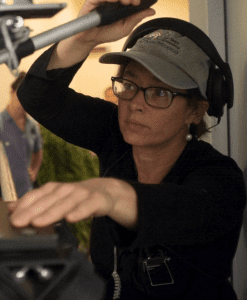 Kimby grew up in the Colorado and New Mexico area but moved around to mostly small towns where she was in the unique position of being the only child with hearing aids at the local school. Since she sometimes lived in rural areas, the geographic and social isolation was challenging. Kimby joked about the challenge of having to walk a couple of miles home from school and cutting across a neighbor’s field only to be chased by bull cows. “I never heard them coming, [and] being butted into the air is terrifying!” Aside from that kind of challenge, the rural teachers were sometimes hard-pressed to know how to handle Kimby’s needs.
While attending the University of Colorado-Boulder for her undergraduate education, Kimby took a French New Wave class. It was the first time she experienced subtitles. “It was such magic to finally be reading subtitles, like almost everyone else in the class, and to be with the plot!” she recalled. “I realized that visual storytelling was a world that made sense to me, and it was such a special feeling to find a home and focus for my interest.”
While attending Southern Methodist University (SMU) to get her graduate degree in Communications, she requested a notetaker, which made a world of difference. However, when she attended the American Film Institute (AFI) for her second master’s, they were unable to provide the same accommodation. Through a private donation, she received new hearing aids with a microphone for the speaker, which was often helpful.
Recognition
Before Kimby attended AFI, she received a Student Academy Award for her graduate thesis from SMU – a personal documentary titled “LISTEN.” It was named after the LISTEN Foundation established by her childhood audiologist and speech therapist Doreen Pollack. “She was a tremendous influence on my life and the direction it took, so it was special to me to make a film that conveyed my specific point of view and experience,” she explained. This is the same award that Spike Lee won. Kimby is hoping to upload this film to a place where people can pay a nominal fee to view.
Film Industry
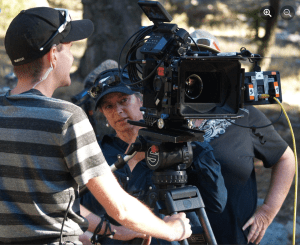 Since graduating from the AFI, Kimby has been working as a director or photographer for documentaries, indie features, narrative shorts, some Sesame Street Cookie Monster episodes, and more. She has her own small production company – focused on cinematography/camera operating services – called Hand Foot Productions, LLC. The name is in honor of her father, “who had an atrocious hand-foot sculpture that everyone hated, but now when I think of it, and him, it makes me smile.”
Kimby thinks her deafness has helped her better vet her options in the film industry and helped her focus her skill set on being visual. At times, she has used separate microphone systems for the director and the crew. She can also wear multiple headsets on occasion, “which can be creative.” She uses an eartech headset system that works “well enough,” but it isn’t perfect. She used to take the plastic earpiece from the walkies and connect her hearing aid mic directly to the air piece, taping them together. It worked in a DIY way but was a bit clunky. She’s hoping to find a better solution.
When asked what advice she would give people with hearing loss who are interested in the film industry, Kimby replied, “If you have a dream, a vision, go for it. Give it all you have and then some. However, it can be difficult, and it’s always useful to have as broad and deep a skill set as you can. Grow your community, your brand, your unique sense of style, and share it loudly and with joy! And try to have fun and evolve as a human while also doing the most excellent work you can with what you have. Take lots of classes and keep growing technically.”
Para la directora de fotografía Kimby Caplan, la sordera es una ventaja
La galardonada directora de fotografía Kimby Caplan está acostumbrada a que le digan que su sordera puede ser un obstáculo en su profesión. A veces a los productores les preocupa que sea difícil comunicarse con ella, pero Kimby considera que su pérdida auditiva es una ventaja.
Diagnóstico
El camino hacia la industria cinematográfica no siempre fue fácil. Gracias a su abuela paterna, que se dio cuenta de que Kimby no respondía al ruido de la aspiradora cuando se encontraba en su proximidad, cuando el resto de sus nietos habían llorado al escuchar el ruido, a Kimby se le diagnosticó la pérdida auditiva cuando tenía un año. «Pensó que era muy valiente o que tenía sordera, y sugirió que me hicieran una revisión», explica Kimby.
Como nadie más en la familia tiene pérdida auditiva, el diagnóstico fue inesperado e inicialmente estresante. Dado que Kimby tenía alguna audición residual, aproximadamente un 10 % en cada oído, sus padres consideraron que la modalidad de comunicación más adecuada era la escucha y el lenguaje hablado. Trabajó con la audióloga pionera Doreen Pollack. Al principio, Kimby utilizaba audífonos analógicos binaurales, pero actualmente lleva un audífono digital.
Crecer con pérdida auditiva
Kimby creció en la zona de Colorado y Nuevo México, pero vivió en ciudades en su mayoría pequeñas donde era la única persona que utilizaba audífonos en la escuela local. Como a veces residía en zonas rurales, el aislamiento geográfico y social era todo un reto. Kimby bromeaba sobre el reto que suponía tener que caminar un par de kilómetros desde la escuela hasta su casa y atravesar el campo de un vecino con vacas bravas que la perseguían. «¡Nunca las oí venir y que de una embestida salgas volando es terrorífico!». Aparte de este tipo de retos, a los maestros rurales a veces les costaba entender las necesidades de Kimby.
Mientras cursaba sus estudios universitarios en la University of Colorado-Boulder, Kimby asistió a una clase de la Nueva Ola francesa. Por primera vez, supo que existían los subtítulos. «¡Fue mágico leer por fin subtítulos, como casi todos los de la clase, y seguir la trama!», recuerda. «Me di cuenta de que la narración visual era lo que necesitaba y fue una sensación muy especial encontrar un hogar y un foco de interés».
Mientras estudiaba en la Southern Methodist University (SMU) para obtener su licenciatura en Comunicación, solicitó la asistencia de un tomador de apuntes, lo que supuso una gran diferencia. Sin embargo, cuando cursó su segundo máster en el American Film Institute (AFI), no pudieron proporcionarle las mismas facilidades. Gracias a una donación privada, recibió unos audífonos nuevos con micrófono para el orador, lo que le resultó de gran utilidad.
Reconocimiento
Antes de estudiar en el AFI, Kimby recibió el premio Student Academy Award por su tesis de posgrado en la SMU: un documental personal titulado «LISTEN». Lleva el nombre de la Fundación LISTEN, creada por Doreen Pollack, la que fuera en su infancia su audióloga y logopeda. «Fue una persona que influyó enormemente en mi vida y en el rumbo que tomó, por lo que consideré oportuno realizar una película que transmitiera mi punto de vista y mi experiencia específicos», explica. Se trata de mismo premio que ganó Spike Lee. Kimby espera poder subir esta película a un sitio donde la gente pueda pagar una cantidad simbólica por verla.
La industria cinematográfica
Tras graduarse en el AFI, Kimby ha trabajado como directora o fotógrafa de documentales, largometrajes independientes, cortometrajes narrativos, algunos episodios del Monstruo de las galletas de Plaza Sésamo y mucho más. Posee una pequeña productora propia, centrada en servicios de cinematografía/operación de cámara, llamada Hand Foot Productions, LLC. El nombre es en honor a su padre, «que tenía una escultura espantosa de mano-pie que no gustaba a nadie, pero que ahora cuando pienso en ella, y en él, me hace sonreír».
Kimby cree que su sordera le ha ayudado a examinar mejor sus opciones en la industria cinematográfica y a centrar sus habilidades en la representación visual. En ocasiones, ha utilizado sistemas de micrófono independientes para el director y el equipo. También puede llevar varios auriculares en ocasiones, «lo que puede ser creativo». Utiliza un sistema de auriculares de tecnología auditiva que funciona «bastante bien», pero no es perfecto. Solía utilizar el auricular de plástico de los walkies y conectar el micrófono de su audífono directamente a la pieza aérea, pegándolos con cinta adhesiva. Funcionaba a modo de bricolaje, pero era un poco tosco. Espera encontrar una solución mejor.
Cuando le preguntamos qué consejo daría a las personas con pérdida auditiva interesadas en la industria cinematográfica, Kimby responde: «Si tienes un sueño, una visión, ve a por ello. Da todo lo que tengas y más. Sin embargo, puede ser difícil, y siempre es útil disponer de un conjunto de habilidades tan amplio y profundo como sea posible. Procura que crezca tu comunidad, tu marca, tu sentido único del estilo ¡y compártelo en voz alta y con alegría! Y trata de divertirte y evolucionar como ser humano mientras realizas el trabajo más excelente que puedas con lo que tengas. Toma muchas clases y sigue creciendo técnicamente».
