Listening and Spoken Language
Whether you are working with a professional who follows the auditory-verbal approach (A-V) or the auditory-oral approach (A-O), the goal of Listening and Spoken Language (LSL) is the same: to combine early identification and intervention with appropriate hearing technology to enable a child with hearing loss to develop language skills comparable to their hearing peers by the time they enter first grade.
Professional Support
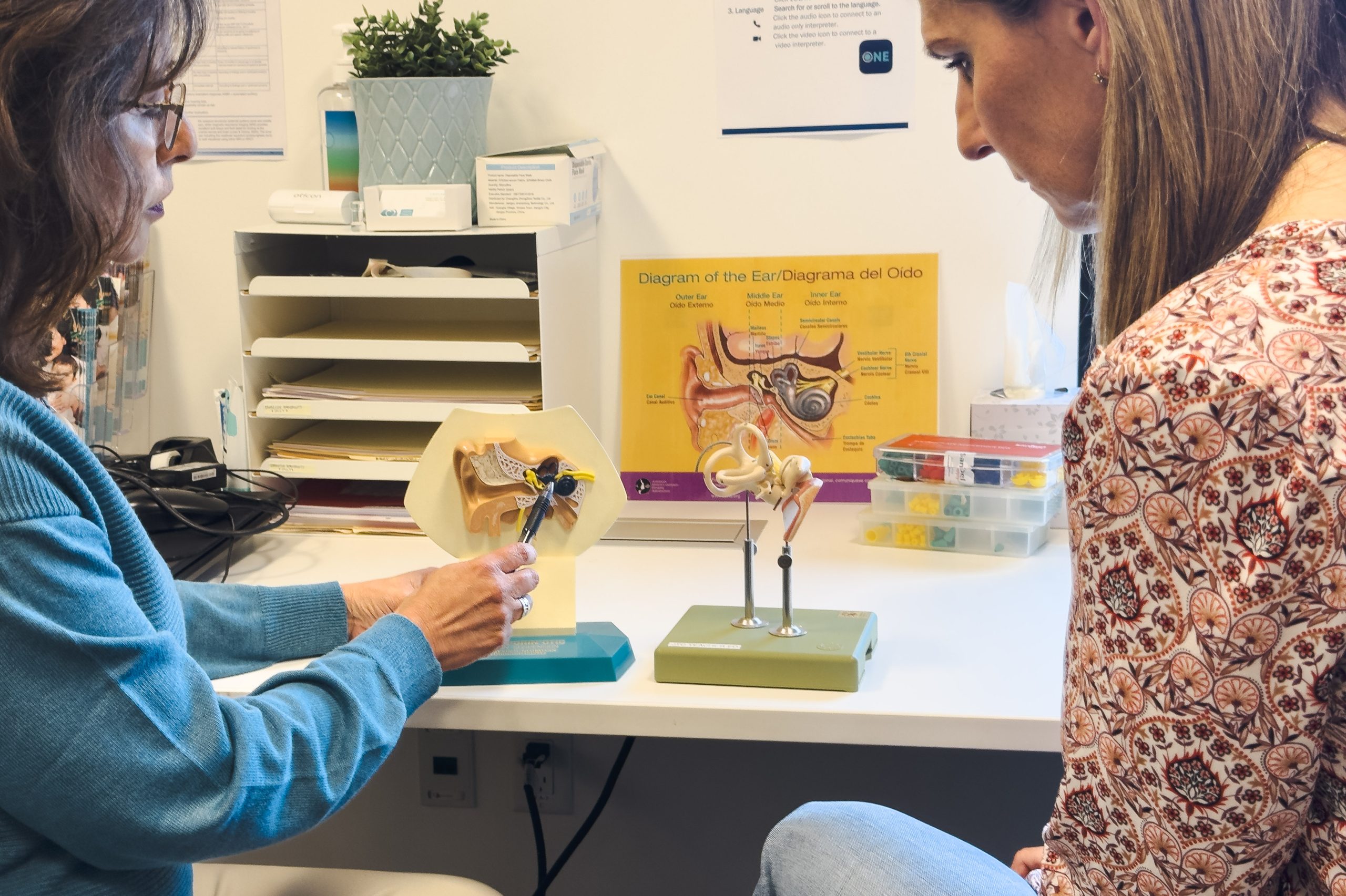
Families who choose a listening and spoken language outcome for their child should seek out a teacher of the deaf, speech-language pathologist or audiologist who is specially trained to help you help your child develop listening and spoken language. Professionals who are certified in supporting families and children to develop listening and spoken language are known as Listening and Spoken Language Specialists (LSLSTM) and are designated as either LSLS Certified Auditory-Verbal Educators (LSLS Cert. AVEd) or LSLS Certified Auditory-Verbal Therapists (LSLS Cert. AVT.) These professionals support and coach parents and caregivers in your role as your child’s most important teacher of language.
Auditory Stimulation and Hearing Assistive Devices
The first step is to make sure your child receives consistent access to sound, especially speech. Infants need appropriate amplification no later than 3 months of age.
The type of hearing assistive device used for auditory stimulation will depend on your child’s age and the severity of the hearing loss. It is very important that you speak to your audiologist about the options available to your child and what technology may best suit his or her needs. Regardless of what device your family chooses, the goal will always be to teach the child how to make the best possible use of hearing and to “learn to listen.”
Hearing Aids
One of the first steps is to fit your child with hearing aids. Regardless of the range of hearing loss, fitting your baby with hearing aids right away improves your child’s access to sound and maximizes the window of opportunity to acquire language. Infants as young 2 weeks old can be fitted with hearing aids.
Depending on the degree of your child’s hearing loss, hearing aids will enable your baby to hear many sounds, including environmental sounds (a dog barking or a rattle shaking) and the sound of speech. Hearing aids work by boosting the intensity (or loudness) level of sounds at different frequencies (or pitches). Hearing aids can also be programmed to fit the needs of individual hearing patterns, such as boosting intensity level for high frequency sounds that your child may not hear at all and less for low frequency sounds that your child may hear better.
It is important to note that hearing aids do not correct hearing the same way that glasses correct vision. Hearing aids amplify all sounds, so individual sounds may be somewhat distorted and it may be difficult for your child to distinguish and understand your voice from background noise in loud environments. Regular sessions with an auditory-verbal practitioner will help your child distinguish these sounds.
Cochlear Implants
Cochlear implants were developed in the 1970s to help individuals who are profoundly deaf and gain little or no benefit from hearing aids.
When hearing is functioning normally, the inner ear converts sound waves into electrical impulses, which are sent to the brain and recognized as sound. A cochlear implant works in a similar manner – when surgically implanted behind the ear and in the cochlea, the electronic device is able to bypass damaged hearing cells and stimulate the auditory nerve to restore partial hearing. Cochlear implants provide enhanced sound detection and a greater potential for understanding speech.
If your child receives little to no benefit from hearing aids, has a severe-to-profound hearing loss and is at least 12 months old, he or she may be a candidate for a cochlear implant.
Listening and Spoken Language Therapy
The most important step after providing your child with access to sound through hearing aids, cochlear implants or both is to begin listening and spoken language therapy. Although your child is hearing sound, he or she still needs to learn to understand the sounds by learning to listen and then to translate that sound into spoken language. This type of therapy will help your child learn how to hear and speak. Family-centered early intervention services promoting the use of listening and spoken language should start no later than 6 months of age.
You can expect to actively participate in your child’s listening and spoken language learning process. Through guidance, coaching and demonstration, parents become the primary facilitators of a child’s spoken language development. With time, you’ll will begin to see that your child can have access to a full range of academic, social and occupational choices throughout his or her life!
It is essential that parents establish an environment at home that facilitates listening and spoken language. This includes speaking to your child even when his/her eyes are focused away from you, ensuring your child’s hearing devices are working properly, practicing a variety of listening activities with the child as learned during therapy sessions, and including other family members in the therapy at home. Therapy sessions after the child’s hearing devices have been provided are essential to establish speech and language skills.
- Early identification of the child’s type and degree of hearing loss. There are now very simple tests that can be performed with infants to identify hearing loss. They do not hurt and the child doesn’t have to actively participate.
- Fitting of hearing aids as soon as possible after the hearing loss has been identified. Ask if your child’s audiologist has a hearing aid loaner program or whether a statewide hearing aid loaner bank exists.
- Use of amplification 100% of the child’s waking hours within two to three weeks of the initial fitting. Remember, hearing is something we do all the time and it is critical for a baby’s learning brain to have constant, meaningful access to sound.
- Observation of the child’s response to sound. Parents and professionals work together to determine how well the child is learning through hearing. These observations will help determine whether the hearing aids need adjustments, or if a cochlear implant is recommended.
- Immediate enrollment in early intervention with a professional who specializes in facilitating listening and spoken language in infants and young children. To learn more about early intervention services in your local area, contact the National Center on Hearing Assessment and Management and click on States.
- An inclusive education in the regular classroom once a child is school aged.
- Hearing, speech and language stimulation at home throughout childhood.
AG Bell supports and advocates for the families of children who are deaf or hard of hearing who choose listening and spoken language, and for the teachers and therapists who provide professional services to them. For more than a century, AG Bell has strived to ensure that every child and adult with hearing loss has the opportunity to receive early intervention to listen, talk, and thrive in mainstream society.