
Rachel Raak has always loved being outdoors, especially during Michigan winters. But she constantly dealt with hearing aid feedback and discomfort whenever she wore beanies, winter hats, helmets, or tighter headwear. It became one of those everyday frustrations where she kept thinking there had to be a better solution. She reached out to the hearing industry, but never received a response. Eventually she realized there really wasn’t a product specifically designed to solve the issue, so she decided to create one herself.
Thus, SolaceShield was born.
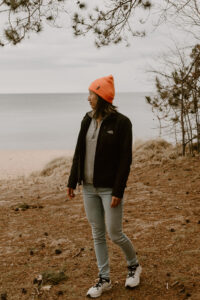 Rachel, 27, was born deaf and wears two Cochlear Baha systems. As a Master’s graduate in Outdoor Recreation and Nature-Based Tourism, accessibility has always been central to her work and to how she experiences the outdoors, her website states.
The process of developing SolaceShield took roughly about a year from the original idea to having the product available publicly. A lot of that time involved testing different shapes, sizes, and materials to figure out what worked comfortably with different hearing devices and headwear. Rachel worked with the Innovate Marquette team to bring the concept to market. It is currently patent pending.
One of the biggest things Rachel learned was the importance of real-world testing. “It’s one thing for an idea to sound good, but another for it to actually work while someone is skiing, running, walking outside, or simply wearing a winter hat all day,” she said.
It seems impossible that no one has thought of this concept before. But maybe it makes sense. “I think sometimes the best ideas come from solving very specific lived experiences,” Rachel said. “Hearing aid users have adapted to these challenges for years, so many people probably just accepted it as part of life instead of thinking a solution could exist.”
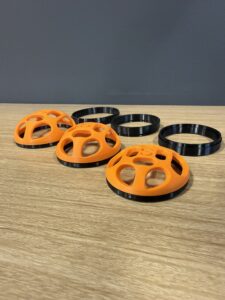
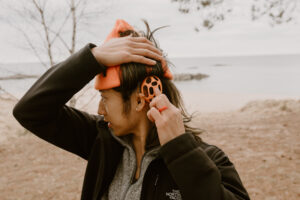 Much of the product’s growth has been organic through social media, particularly TikTok and Instagram. On those platforms, Rachel has shared her personal story, real world demonstrations, winter and outdoor use cases, and videos explaining the problem SolaceShield solves. She thinks authenticity has been a huge part of why people connect with it. She has started outreach to audiology clinics and hearing professionals, because many patients experience the same frustrations but may not realize a solution exists.
The response has been really encouraging to Rachel, who lives in Marquette, Mich., where she works as a Community Economic Development Coordinator with the Lake Superior Community Partnership. What has meant the most to her are messages from people saying things like, “I’ve struggled with this for years,” or parents sharing how much it helped their child wear hats more comfortably. “Hearing those stories makes the entire process worth it,” Rachel said.
As the SolaceShield website states, “SolaceShield is designed to reduce feedback caused by winter hats while keeping hearing devices protected and fully functional. No one should have to choose between staying warm and hearing clearly. My message is simple but powerful: Don’t let the word ‘disability’ define your limits.”
SolaceShield is sold individually for $30 each. The soft band hearing aid protector meant to be used alongside SolaceShield costs $8. An extension may be needed depending on fit and comfort. Visit https://solaceshield.shop/ for more details!
Learn more:
Convertir la incomodidad en innovación
A Rachel Raak siempre le ha encantado estar al aire libre, sobre todo durante los inviernos de Míchigan. Sin embargo, siempre que se ponía gorros de lana, gorros de invierno, cascos u otras prendas ajustadas en la cabeza, sufría constantes acoples y molestias en sus audífonos. Se convirtió en una de esas frustraciones cotidianas que le hacían pensar una y otra vez que tenía que haber una solución mejor. Se puso en contacto con el sector de la audición, pero nunca obtuvo respuesta. Finalmente se dio cuenta de que no existía ningún producto diseñado específicamente para resolver el problema, así que decidió crearlo ella misma.
Así nació SolaceShield.
Rachel, de 27 años, nació con sordera y lleva dos sistemas Cochlear Baha. Según su página web, como titulada de máster en Recreación al Aire Libre y Turismo de Naturaleza, la accesibilidad siempre ha sido fundamental en su trabajo y en su forma de vivir la naturaleza.
El desarrollo de SolaceShield llevó aproximadamente un año, desde la idea original hasta que el producto estuvo a la venta. Gran parte de este tiempo se dedicó a probar distintas formas, tamaños y materiales para averiguar qué resultaba cómodo con diferentes audífonos y accesorios para la cabeza. Rachel trabajó con el equipo de Innovate Marquette para llevar el concepto al mercado. Actualmente la patente está en trámite.
Una de las principales lecciones que aprendió Rachel fue lo importante que es probar el producto en condiciones reales. «Una cosa es que una idea suene bien y otra muy distinta que funcione de verdad mientras alguien esquía, corre, pasea al aire libre o simplemente lleva un gorro de invierno todo el día», explica.
Parece imposible que a nadie se le hubiera ocurrido antes esta idea. Pero quizá tenga sentido. «Creo que a veces las mejores ideas surgen de dar solución a experiencias vividas muy concretas», comenta Rachel. «Los usuarios de audífonos llevan años adaptándose a estas dificultades, por lo que es probable que mucha gente lo haya aceptado sin más como parte de la vida, sin pensar que pudiera existir una solución».
Gran parte del crecimiento del producto ha sido orgánico, a través de las redes sociales, especialmente TikTok e Instagram. En estas plataformas, Rachel ha compartido su historia personal, demostraciones en situaciones reales, ejemplos de uso en invierno y al aire libre, y videos que explican el problema que resuelve SolaceShield. Cree que la autenticidad ha sido clave para que la gente conecte con el producto. Ha empezado a contactar con clínicas de audiología y profesionales de la audición, ya que muchos pacientes sufren las mismas frustraciones, pero quizá no sepan que existe una solución.
La respuesta ha sido muy alentadora para Rachel, que vive en Marquette (Míchigan), donde trabaja como coordinadora de desarrollo económico comunitario en la Lake Superior Community Partnership. Lo que ha tenido mayor importancia para ella son los mensajes de personas que dicen cosas como «Llevo años lidiando con esto», o de padres que cuentan lo mucho que ha ayudado a su hijo a llevar gorro con más comodidad. «Escuchar esas historias hace que todo el proceso merezca la pena», asegura Rachel.
Como se indica en la página web de SolaceShield: «SolaceShield está diseñado para reducir los acoples causados por los gorros de invierno, a la vez que mantiene los audífonos protegidos y plenamente operativos. Nadie debería tener que elegir entre abrigarse y oír con claridad. Mi mensaje es sencillo pero contundente: no deje que la palabra “discapacidad” defina sus límites».
SolaceShield se vende por unidades a 30 USD cada una. El protector para audífonos de banda blanda (softband), pensado para usarse junto con SolaceShield, cuesta 8 USD. Puede ser necesaria una extensión en función del ajuste y la comodidad. Visite https://solaceshield.shop/ para obtener más información.
Más información:
