
In June 2025, 17-year-old Nivrritii (Nivi) Mahesh, who was born profoundly deaf and is a bilateral cochlear implant recipient, performed her Bharathanatyam Arangetram: a debut solo classical dance performance traditionally accompanied by a live orchestra. To the best of her knowledge, she is among the first in the world with cochlear implants to achieve this feat.
Her mother, Aishwarya Chakravarthy, who teaches Bharathanatyam dance, said the art “demands not only rhythm and expression but also nuanced understanding of melody and intricate syllabic patterns called jathis. Nivi’s journey required immense perseverance; she relied on years of practice, muscle memory, visual cues, and innovative stage adaptations to synchronize seamlessly with live musicians.”
Hearing Loss Diagnosis
Nivi, a Unionville, CT, high school junior, was born in India with a profound bilateral hearing loss that was diagnosed through newborn hearing screening. After exploring several approaches, including sign language and total communication, Nivi’s parents decided to focus on Listening and Spoken Language because they wanted to give her access to the world of sound and speech.
The family moved to the United States so Nivi could have her cochlear implant surgery at age 4 1/2 and receive additional hearing support. She didn’t start speaking until after her surgery. Her mother said that she used art and gestures to communicate from a young age, even creating her informal signs, like drawing a circle with a dot in the middle to represent Target. This early comfort with expression made it easier for her to connect with Bharathanatyam, where hand gestures (or mudras) are central. While expression came naturally, rhythm was a greater challenge as rhythm in Indian classical music is subtle and layered.
Exposure to Dance
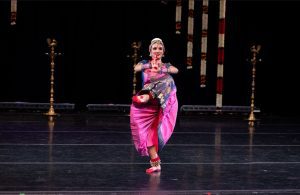 Chakravarthy taught dance in her basement, where Nivi often sat and watched. Nivi started dancing when she was 7 years old. “Living in the U.S., it can be difficult to maintain my Indian roots, and Bharathanatyam served as a way to allow me to be closer to my religion and culture,” she said.
In 2023, Nivi and her mother agreed that 2025 would be the year she did her Arangetram, which means “ascending the stage” in Tamil. It marks the transition from a student to a performing artist. According to Chakravarthy, it typically happens after 7-10 years of rigorous training once the teacher feels the student is ready to present a full-length traditional repertoire independently.
Excited, Nivi watched a lot of other students do theirs and learned the dances from her mom and her mom’s teacher. She started memorizing on her own, but when she tried dancing with the audio, she ended up behind, ahead, or offbeat. Frustrated that she couldn’t get it right, Nivi relied on counting and timing, which was not always reliable. For a year, she tried to practice daily after school, in addition to most of her weekends and breaks. It wasn’t easy, particularly having to memorize and practice seven dance pieces.
Hearing Challenges
It took months of trial and error to figure out how to make the performance work seamlessly for Nivi. She was insistent on not using recorded music or having an Arangetram that was significantly different than a traditional one.
The first test was to see if she could follow the live orchestra naturally without any additional support, but they soon realized she was missing several rhythmic cues. Next, they placed the DM (digital modulation) microphone near the main drummer so Nivi could hear the rhythm more clearly, but that overwhelmed her hearing. All she could hear was the drum, which drowned out everything else.
Next, Chakravarthy tried wearing the DM herself, softly counting the rhythm, but each time she unmuted the mic, it overrode Nivi’s ability to hear the rest of the orchestra and threw off her auditory balance.
The real breakthrough came just a week before the show, when the sound engineer figured out a way to connect his mixer directly to the DM system to create two separate custom mixes: one that provided a balanced blend of all the orchestra members’ sounds tailored to Nivi’s preferences and another that isolated Chakravarthy’s voice.
“This setup allowed her to hear both the music and my rhythmic cues at just the right levels,” Chakravarthy said. “During certain sequences, I could recite jathis that both she and the audience heard, while at other times, I counted silently through her private channel to help her stay in rhythm. We also added a confidence monitor on stage so I could give subtle visual cues if she started to drift. Together, these adjustments transformed the experience, and for the first time, Nivi could truly dance with the music rather than to it.”
An unexpected challenge came from the elaborate jewelry traditionally worn in Bharathanatyam. Some of Nivi’s pieces covered her ears and interfered with her cochlear implants, so they had to carefully modify the fit and positioning to ensure her hearing devices stayed functional throughout the performance.
Managing the switch between the two audio channels is an ongoing challenge. The transition between mixes sometimes caused confusion when Nivi was tuned into one channel and it suddenly shifted, disrupting her focus. They’re still working on fine-tuning that mechanism to make the switching smoother and more intuitive for future performances.
The Performance
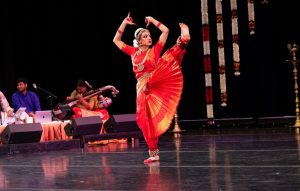 Over 400 people attended Nivi’s Arangetram. Surprisingly, Nivi wasn’t that nervous because she knew she had put in the work and the technological strategies were the most they could do. Most of the time, Nivi remained on beat. Whenever she was going too fast or too slow. She saw her mom in the confidence monitor, where she gestured to Nivi. “I could hear her beats carrying me through the hard parts, and she kept saying, ‘Smile,’ because I was stressed and wanted to get the steps right and on beat.”
Afterward, Nivi said, “I felt really relieved and somewhat satisfied. Of course, there are some parts I would like to improve on, but I was confident with what I managed to achieve.” In fact, her performance was so successful that many people didn’t even realize she was deaf.
AG Bell Advocacy
Nivi is dedicated to spreading awareness and creating community as part of the CT AG Bell youth committee. Among the work they’ve done so far is planning tips and facts for students. Getting to meet others like her has been valuable. “I have an Indian community, but with AG Bell, I found my deaf community, where I belong,” Nivi said.
Future Goals
Nivi plans to continue dancing. She has done some solo dances in the temple and is currently prepping an upcoming dance production. She also hopes to pursue a career in a healthcare and STEM-related field, like bioengineering. “I have seen the firsthand impact of my cochlear implants, and I hope to bring that kind of meaningful impact to other people by making medical devices,” she said. “I have always been fascinated by the heart, and I hope to create medical devices for it.”
Her last words of advice are to pursue what you love without letting hearing loss hold you back. “With hard work and immense support, anything is possible,” she said.
Watch Nivi shine on stage:
Un debut histórico en la danza gracias a soluciones creativas ante retos auditivos
En junio de 2025, Nivrritii (Nivi) Mahesh, de 17 años, que nació con sordera profunda bilateral y es usuaria de implantes cocleares en ambos oídos, realizó su Arangetram de Bharathanatyam: una presentación individual de danza clásica que se acompaña tradicionalmente de una orquesta en vivo. Por lo que sabe, es una de las primeras personas del mundo con implantes cocleares en lograr esta hazaña.
Su madre, Aishwarya Chakravarthy, que es profesora de danza Bharathanatyam, explica que este arte «exige no solo ritmo y expresión, sino también una comprensión pormenorizada de la melodía y de los intrincados patrones silábicos llamados jathis. En su trayectoria, Nivi ha mostrado una enorme perseverancia, con muchos años de práctica, memoria muscular, señales visuales y adaptaciones escénicas innovadoras para sincronizarse a la perfección con los músicos en vivo».
Diagnóstico de pérdida auditiva
Nivi, que estudia actualmente secundaria en Unionville (Connecticut), nació en la India con una sordera profunda bilateral detectada en el cribado auditivo neonatal. Después de explorar varios enfoques, incluidas la lengua de signos y la comunicación total, sus padres optaron por el enfoque de Escucha y Lenguaje Hablado porque querían que tuviera acceso al mundo del sonido y el habla.
La familia se trasladó a los Estados Unidos para que Nivi pudiera someterse a una cirugía de implantes cocleares cuando tenía cuatro años y medio, y recibir apoyo auditivo adicional. No empezó a hablar hasta después de la operación. Su madre cuenta que, desde muy pequeña, se comunicaba mediante arte y gestos, e incluso creaba sus propios signos informales, como dibujar un círculo con un punto en el centro para representar «objetivo». Esta facilidad para expresarse desde tan temprana edad le facilitó conectar con el Bharathanatyam, donde los gestos con las manos (o mudras) son fundamentales. Aunque la expresión le resultaba natural, el ritmo le supuso un enorme reto, ya que en la música clásica india es sutil y multicapa.
Exposición a la danza
Aishwarya impartía clases de danza en el sótano de su casa, donde Nivi solía sentarse a mirar. La niña comenzó a bailar cuando tenía 7 años. «Viviendo en los Estados Unidos, me es más difícil mantener mis raíces indias y el Bharathanatyam me ha permitido acercarme más a mi religión y a mi cultura», afirma.
En 2023, Nivi y su madre acordaron que 2025 sería el año de su Arangetram, que significa «subir al escenario» en tamil y marca la transición de alumno a artista profesional. Según Aishwarya, suele ocurrir después de 7-10 años de riguroso entrenamiento, una vez que el profesor considera que el alumno está preparado para presentar un repertorio tradicional completo de forma independiente.
Entusiasmada, Nivi observó muchas Arangetrams de otros alumnos y aprendió las danzas de su madre y de la maestra de esta. Empezó memorizando por su cuenta, pero al practicar con el audio se adelantaba, se retrasaba o perdía el ritmo. Frustrada por no lograrlo, recurrió a contar y medir el tiempo, lo cual no siempre era confiable. Durante un año, practicó casi todos los días después de las clases, además de la mayor parte de los fines de semana y las vacaciones. No fue fácil, sobre todo teniendo que memorizar y practicar siete piezas de danza.
Desafíos auditivos
Se necesitaron meses de ensayo y error para lograr que la actuación de Nivi funcionara a la perfección. La joven insistió en no utilizar música grabada ni realizar una Arangetram muy diferente a la tradicional.
La primera prueba fue comprobar si podía seguir a la orquesta en vivo de forma natural sin ningún apoyo adicional, pero pronto se dieron cuenta de que se perdía varias señales rítmicas. A continuación, colocaron el micrófono de modulación digital (DM) cerca del tambor principal para que Nivi pudiera oír el ritmo con más claridad, pero le saturaba la audición: solo percibía este instrumento, que ahogaba el resto.
A continuación, Aishwarya probó a ponerse ella misma el DM, contando el ritmo en voz baja, pero, cada vez que activaba el micrófono, se anulaba la capacidad de Nivi de oír al resto de la orquesta y alteraba su equilibrio auditivo.
El verdadero avance se produjo justo una semana antes del espectáculo, cuando el ingeniero de sonido descubrió una forma de conectar su mesa de mezclas directamente al sistema DM para crear dos mezclas personalizadas independientes: una que equilibraba los sonidos de todos los músicos según las preferencias de Nivi y otra que aislaba la voz de Aishwarya.
«Esta configuración le permitía escuchar tanto la música como mis indicaciones rítmicas en los niveles adecuados», explica Aishwarya. «Durante algunas secuencias, yo recitaba jathis que tanto ella como el público escuchaban; en otras, contaba en silencio por su canal privado para ayudarle a mantener el ritmo. También contamos con un monitor en el escenario, que me permitía facilitarle señales visuales sutiles si comenzaba a desviarse. En conjunto, estos ajustes transformaron la experiencia y, por primera vez, Nivi pudo bailar realmente con la música y no simplemente seguirla».
Un reto que no previmos fueron las elaboradas joyas que se llevan tradicionalmente en el Bharathanatyam. Algunas piezas le tapaban los oídos e interferían con los implantes cocleares, por lo que se tuvo que modificar su ajuste y posición para que los dispositivos auditivos funcionaran durante toda la actuación.
Gestionar el cambio entre los dos canales de audio sigue siendo un reto. A veces, la transición entre mezclas causaba confusión cuando Nivi estaba sintonizada en un canal y este cambiaba repentinamente, rompiendo su concentración. Todavía se trabaja en el ajuste de este mecanismo para que el cambio sea más fluido e intuitivo en futuras actuaciones.
La actuación
Más de 400 personas asistieron a la Arangetram de Nivi. Sorprendentemente, Nivi no estaba muy nerviosa porque sabía que había realizado un gran esfuerzo y que las estrategias tecnológicas eran las mejores posibles. La mayor parte del tiempo mantuvo el ritmo. Cuando se aceleraba o se retrasaba, veía a su madre en el monitor, haciéndole gestos. «Podía oír sus golpes de ritmo acompañándome en las partes difíciles y no dejaba de decirme “sonríe”, porque me mostraba tensa, concentrada en hacer bien los pasos y seguir el ritmo».
Nivi asegura: «Me sentí muy aliviada y bastante satisfecha. Claro que hay partes que me gustaría mejorar, pero me siento segura con lo logrado». De hecho, su actuación fue tan buena que mucha gente ni siquiera se dio cuenta de que tenía sordera.
Defensa con AG Bell
Nivi está comprometida con la concienciación y la creación de comunidad como parte del comité juvenil de AG Bell Connecticut. Entre las actividades que han realizado se encuentra la elaboración de consejos y datos útiles para estudiantes. Conocer a otras personas como ella ha sido muy valioso. «Tengo una comunidad india, pero con AG Bell he encontrado a mi comunidad sorda, el lugar al que pertenezco», afirma Nivi.
Metas futuras
Nivi se propone seguir bailando. Ha realizado algunas danzas en solitario en el templo y actualmente se prepara para una próxima producción de danza. También espera dedicarse profesionalmente a un campo relacionado con la salud y las ciencias, como la bioingeniería. «He comprobado de primera mano el impacto de los implantes cocleares y espero aportar este tipo de impacto significativo a otras personas creando dispositivos médicos», afirma. «Siempre me ha fascinado el corazón y espero diseñar dispositivos médicos en este campo».
Su último consejo es que se debe perseguir lo que te guste de verdad, sin dejar que la pérdida auditiva te detenga. «Con esfuerzo y un gran apoyo, todo es posible», asegura.
No deje de ver a Nivi brillando en el escenario:
